
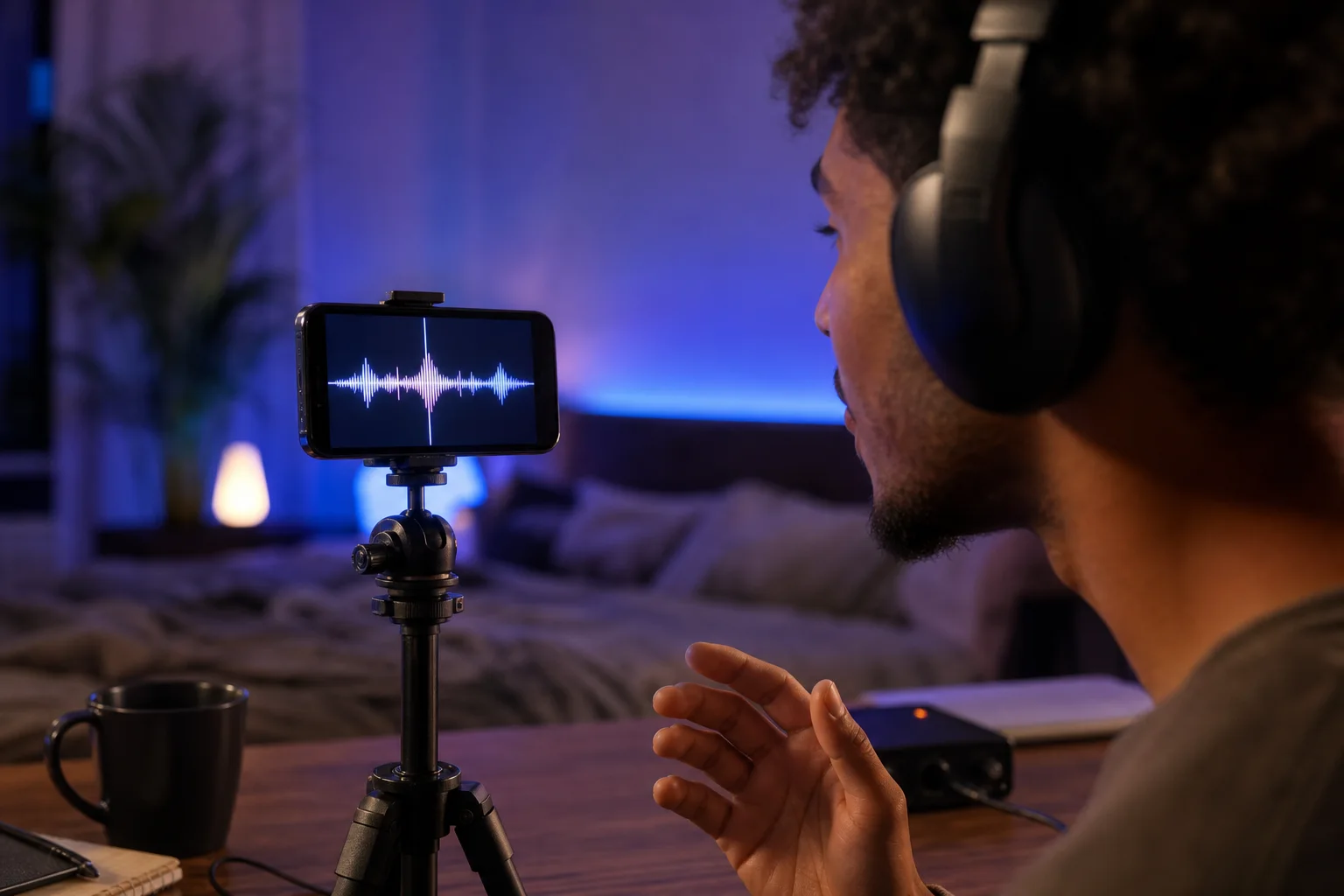
You do not need to turn your living room into a studio to capture a clean voice sample. A phone is often enough when the room is quiet and a few common mistakes are avoided.
The goal is not a dramatic processed sound. It is a clear, natural voice without unnecessary background elements.
Find the quietest part of the room
In practice, move away from open windows, fans, loud computers and very bare walls. Soft furnishings can reduce distracting reflections.
Position the phone simply
For this step, keep the microphone at a consistent distance and slightly off-axis from the mouth to reduce plosive bursts without placing it too far away.
Remove avoidable interruptions
At this point, use silent mode, avoid handling the phone during the take and record a short test before the main sample.
Use your normal speaking voice
In practice, speak at a comfortable level, articulate clearly without acting, and avoid extreme changes in volume.
Check the recording on headphones
A short critical listen can reveal background noise, clipping or handling sounds that may reduce the quality of a personalized voice.
Prepare a first version without overloading the brief
To start a creation, gather only the elements that can meaningfully change the result. One primary intention, a few specific details and a clear musical or visual direction are more useful than a prompt full of competing requests.
If you are torn between two strong directions, make separate variants. That gives you a real comparison instead of one vague compromise between incompatible ideas.
- define what the result should make someone feel;
- keep the names, facts or elements that must remain;
- remove private information that should not appear;
- separate what the creation should say from how it should sound or look;
- keep the original brief so you can change one variable at a time.
Improve the result after the first listen or preview
For this step, do not stop at whether you like the result. Identify the reason: is the message clear, does the mood fit, is one section overloaded, or does the voice, image or structure draw attention to the wrong place?
At this point, then change the most important variable first. Changing text, style, intensity and structure at the same time makes it difficult to learn what actually improved the creation.
What makes a result personal rather than generic
In practice, personalization rarely comes from providing the maximum amount of information. It comes from a few details nobody else would have supplied: a phrase, memory, rhythm, image or constraint that genuinely belongs to the project.
For this step, when reviewing your brief, ask whether another person could swap the names and end up with essentially the same story. If so, add one concrete detail and remove one generic statement.
Put the method into practice with DeepZik
DeepZik can create a personalized voice from a recording. A smartphone is often enough for the source when you prioritize a quiet environment and natural delivery.
At this point, explore creating a song with your own voice adds another useful angle to the process.
In practice, create a song even if you cannot sing adds another useful angle to the process.
A simple five-step workflow
- define the intended result in one sentence;
- prepare the best source available: text, voice, image or song depending on the task;
- add only constraints that can meaningfully change the output;
- generate a first version and listen or watch it all the way through;
- change one important variable and compare.
This can look slower than writing one very long prompt, but it often speeds up the process because you can see which instruction caused which effect. You keep the strong parts instead of losing them with every new attempt.
Check what you are comfortable sharing
When preparing to publish, make one final pass over personal information, imported files and the people shown or heard. You should use only content and voices for which you have the required rights or permission.
Frequently asked questions
Do I need to be a musician to use this method?
You do not need to be a musician. The most important part is knowing what you want to express or obtain and giving the creation process enough specific direction.
Does the first generation have to be perfect?
A first generation does not need to be perfect. A first version can reveal what works and what needs more direction. Change one important element at a time instead of rewriting everything.
Can I start from my own words?
Yes. Depending on the creation, you can begin with an idea, text or lyrics you already wrote.