
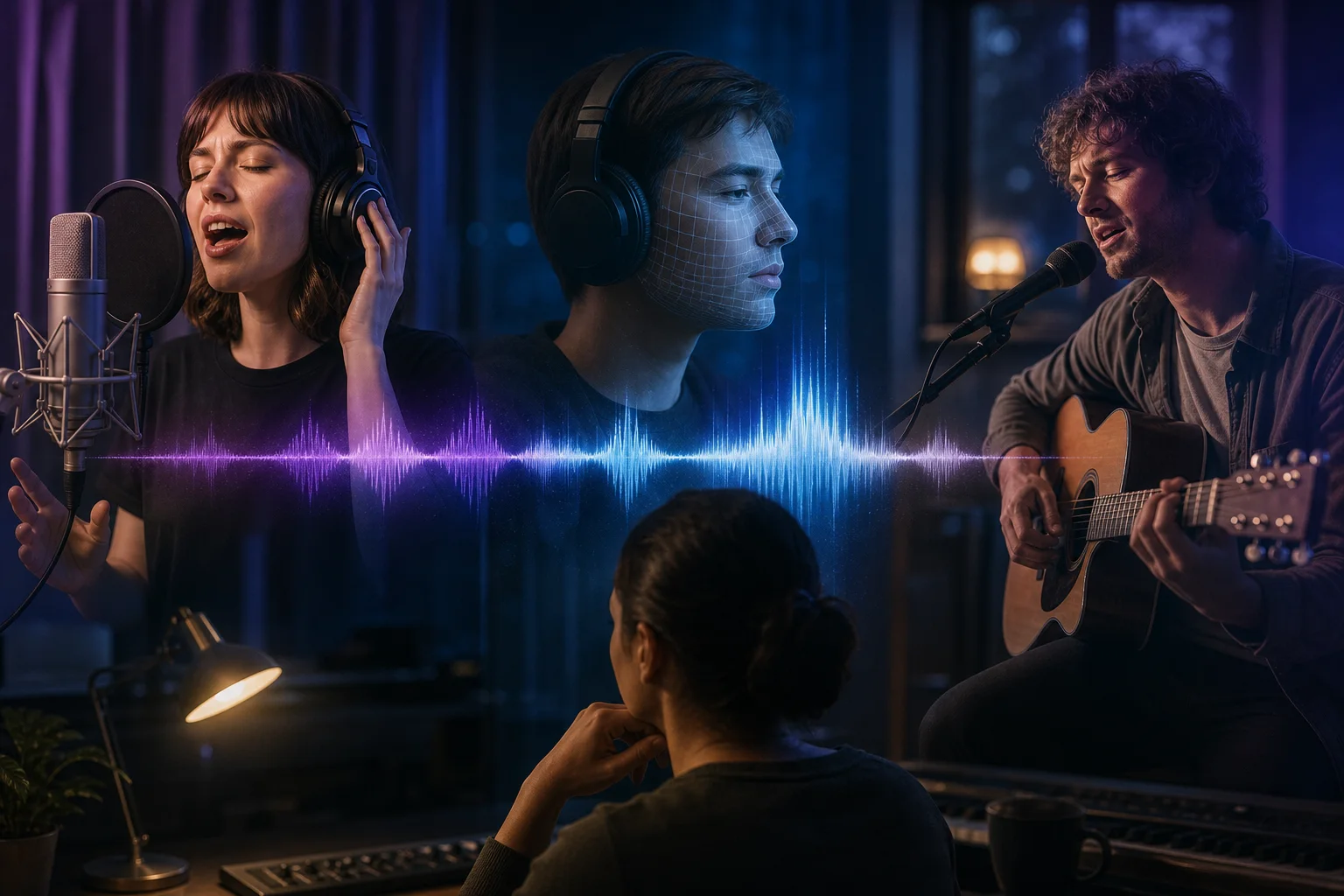
In practice, several tools can change how a voice appears in music without solving the same problem. Treating them as interchangeable often leads to the wrong starting point.
The right workflow depends first on what you already have: a voice recording, an existing song or simply an idea for a new track.
Voice cloning reuses a vocal identity
A personalized voice is created from an authorized sample so it can be used in supported creations. The quality of the source recording therefore matters.
A voice changer starts from a vocal performance
For this step, voice changing acts on an existing performance: timing and expression come from the supplied vocal first, while the vocal character is transformed.
An AI cover starts from an existing song
A cover uses an existing song as the musical starting point and creates a new interpretation. You also need the required rights and permissions for any material you import.
Choose based on what you already have
If you want a new song with a personalized voice, start with the voice workflow. If you have a performance, voice changing is more logical. If you start from an existing song, you are in a cover workflow.
Separate technical capability from permission to use content
A tool being able to process a file does not mean you have the right to use it. Check permissions for voices, recordings and songs you provide.
Prepare a first version without overloading the brief
To start a creation, gather only the elements that can meaningfully change the result. One primary intention, a few specific details and a clear musical or visual direction are more useful than a prompt full of competing requests.
If you are torn between two strong directions, make separate variants. That gives you a real comparison instead of one vague compromise between incompatible ideas.
- define what the result should make someone feel;
- keep the names, facts or elements that must remain;
- remove private information that should not appear;
- separate what the creation should say from how it should sound or look;
- keep the original brief so you can change one variable at a time.
Improve the result after the first listen or preview
At this point, do not stop at whether you like the result. Identify the reason: is the message clear, does the mood fit, is one section overloaded, or does the voice, image or structure draw attention to the wrong place?
In practice, then change the most important variable first. Changing text, style, intensity and structure at the same time makes it difficult to learn what actually improved the creation.
What makes a result personal rather than generic
For this step, personalization rarely comes from providing the maximum amount of information. It comes from a few details nobody else would have supplied: a phrase, memory, rhythm, image or constraint that genuinely belongs to the project.
At this point, when reviewing your brief, ask whether another person could swap the names and end up with essentially the same story. If so, add one concrete detail and remove one generic statement.
Put the method into practice with DeepZik
DeepZik includes several voice workflows: creation with a personalized voice, VoiceChanger and covers. Choose the workflow that matches your starting material instead of forcing one tool into another use.
In practice, explore creating a song with your own voice adds another useful angle to the process.
For this step, see how to create a song that feels like you adds another useful angle to the process.
A simple five-step workflow
- define the intended result in one sentence;
- prepare the best source available: text, voice, image or song depending on the task;
- add only constraints that can meaningfully change the output;
- generate a first version and listen or watch it all the way through;
- change one important variable and compare.
This can look slower than writing one very long prompt, but it often speeds up the process because you can see which instruction caused which effect. You keep the strong parts instead of losing them with every new attempt.
Check what you are comfortable sharing
When preparing to publish, make one final pass over personal information, imported files and the people shown or heard. You should use only content and voices for which you have the required rights or permission.
Frequently asked questions
Do I need to be a musician to use this method?
You do not need to be a musician. The most important part is knowing what you want to express or obtain and giving the creation process enough specific direction.
Does the first generation have to be perfect?
A first generation does not need to be perfect. A first version can reveal what works and what needs more direction. Change one important element at a time instead of rewriting everything.
Can I start from my own words?
Yes. Depending on the creation, you can begin with an idea, text or lyrics you already wrote.