
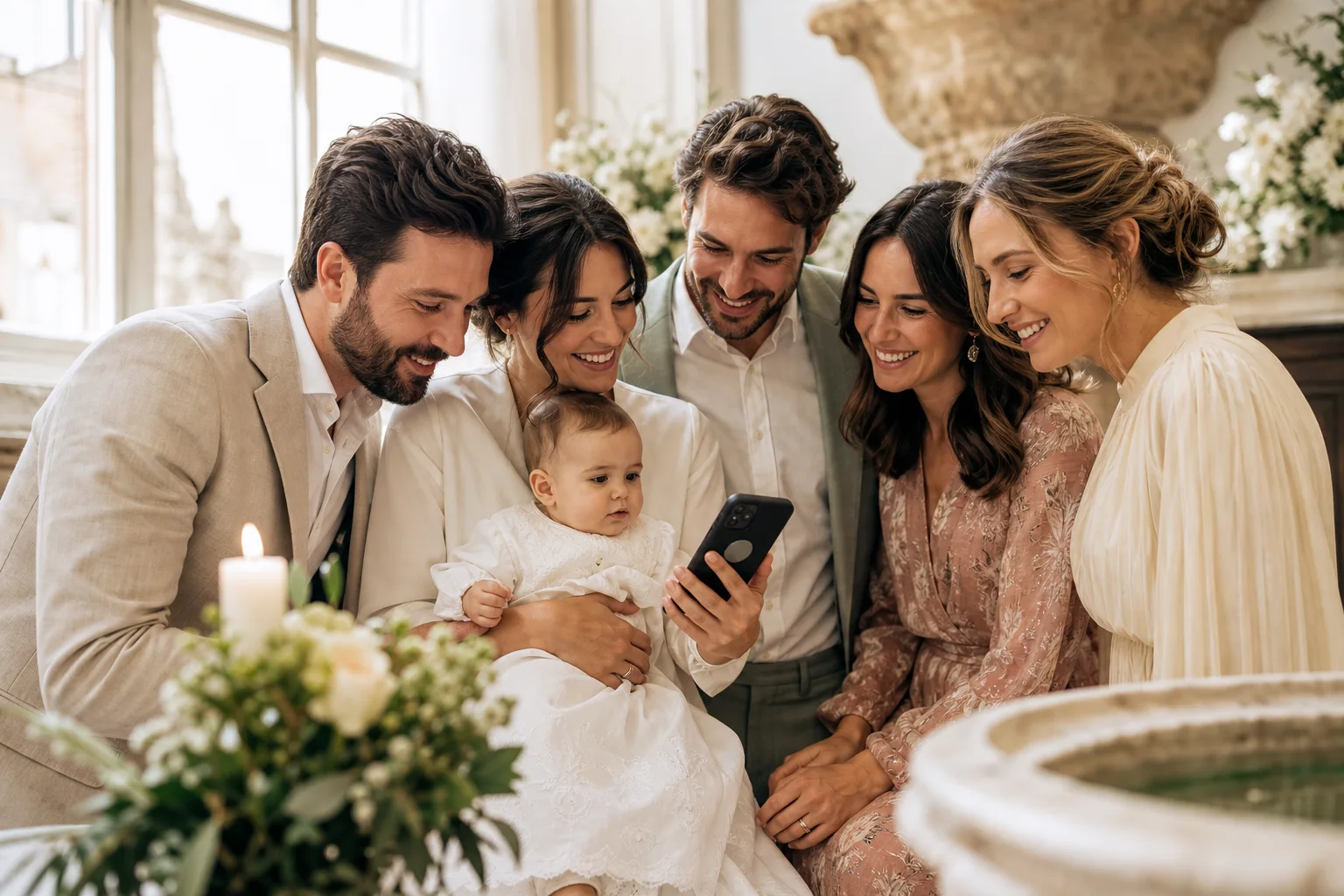
A personalized christening song can become a family keepsake that a child rediscovers years later. It can include the child’s name, the people around them, hopes for the future and the atmosphere of the day, without forcing a religious tone if that is not what the family wants.
The most important starting point is what the family genuinely wants to express. A christening song can be spiritual, family-centered, tender or simply focused on welcoming a child and recognizing their place in a shared story.
Why a personalized song can make a christening memorable
A christening often brings several generations together in one place. Photos preserve faces and gestures; a song can preserve words. It gives parents, grandparents, godparents or other close relatives a way to express a message that remains connected to the day.
The song can also be played years later, when the child is old enough to understand the references. It then becomes more than entertainment for the ceremony: it becomes a message that was saved for the future.
Before creating the song, define the tone of the ceremony
Before writing the brief, decide what the song should represent. Some families want an explicitly faith-based song. Others prefer to focus on family, trust, protection and the future without direct religious references. Both approaches can work when the lyrics respect the meaning the family gives to the event.
If several people are contributing to the gift, agree on one main intention. A song that tries to be solemn, humorous, deeply religious, highly modern and childlike at the same time can lose its identity.
Three types of details that make the song truly personal
Three categories are usually enough for a rich brief: the people involved, memories that already exist and hopes for the future. The goal is not to fill every line with names, but to give the song a few details the family will recognize immediately.
- the child’s name and the names the family genuinely wants to include
- the role of a godparent or another important relative
- a gentle everyday detail: a smile, a bedtime song or a walk together
- a value the family hopes to pass on
- one simple sentence that could become the chorus or central message
Add only details you would feel comfortable hearing in front of the guests. A song can be intimate without revealing private information.
Godparents or parents: choose the right point of view
The narrator changes the emotional color of the lyrics. A song from the parents can focus on welcome and growth. A song from a godparent can sound like a promise to remain present. A collective gift can use a wider family “we.”
Use the same point of view from beginning to end unless there is a clear reason to change it. This keeps the lyrics easy to follow and avoids the feeling that several unrelated texts were combined.
Turning an idea into a song can help clarify that point of view before generation.
Choose a musical atmosphere that suits the moment
An acoustic ballad, gentle piano, bright pop or a lullaby-like atmosphere can all suit a christening. The right choice depends on the family and on when the song will be played: during the meal, in a memory video, after the ceremony or in a quieter setting.
If the track is meant to be replayed when the child is older, avoid making it overly childish. A simple and warm melody can keep its emotional value for longer.
For a softer direction, the principles behind a personalized lullaby can also provide useful ideas, even though a christening song does not need to be a lullaby.
Create the christening song with AI
AI can quickly turn a brief into a musical proposal, but it does not know your family. The quality of the personalization therefore depends on the details you provide and on how clearly you describe the intention.
For example: “a gentle, bright song for Camille’s christening, given by her godmother Nora; mention the family gathering, trust and the promise to be present at important stages of her life; avoid language that sounds overly solemn.” This gives the system a clear direction without writing the lyrics in advance.
DeepZik can start from an idea, a text or lyrics you have already prepared and generate a complete song with music and vocals. The guide to creating music from a prompt can help you organize the information.
Wording to avoid in a christening song
Strong personalization does not require grand statements in every line. The lyrics often become more moving when they stay simple, precise and appropriate for the family.
- inventing religious beliefs the family did not express
- making the child speak as if they personally made promises
- adding so many names that the song loses its thread
- using phrases so general that they could fit any family
- including private information only to prove that the song is personalized
No, a christening song does not need to sound solemn from beginning to end. It can be bright, modern and natural while still respecting the importance of the occasion.
Prepare the listening moment during the celebration
If you plan to play the song for the guests, test the sound in advance and choose a moment when conversations can pause for a few minutes. A surprise song works better when it becomes a small event of its own instead of background music.
You can also include it in a video or send it to relatives afterward. Creating a song that feels like you remains a useful guide for reviewing a first version before sharing it.
Can the song be given later?
Yes. The song can be created for the christening and then given or replayed on a birthday, at a family gathering or even at Christmas. Because it is built around the child’s name, the family relationship and the message being passed on, it can keep its meaning beyond the ceremony itself.
Frequently asked questions
Does the song have to be religious?
No. The tone depends entirely on the family and on the meaning they give to the christening. You can focus on welcome, affection and hopes for the future.
Can the godparents be named?
Yes, when their role is important to the message. Add their names only when doing so makes the lyrics more personal.
Do I need to write the lyrics before using DeepZik?
No. You can start with a detailed brief. If you already have a letter or a few lines written for the child, they can also be used as source material.
How much detail should I give the AI?
Use a few concrete details: the child’s name, the relationship between the people involved, the main emotion, one or two everyday images and what you want the song to say. That is usually enough to avoid a generic result.